UNIT 4 LOGISTICS SERVICE PROVIDER
1. Read the following international words. Define their meanings comparing them to the meanings of the corresponding Russian words:
category, complex, distributor, information, logistics, operational, physical, role, service, sub-contracted, terminology.
2. Complete the table using suitable forms:
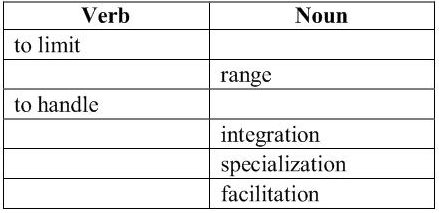
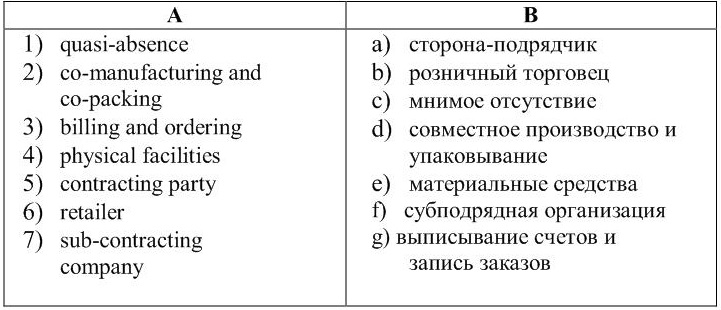
3. Translate English words and phrases in column A using Russian words and phrases from column B:
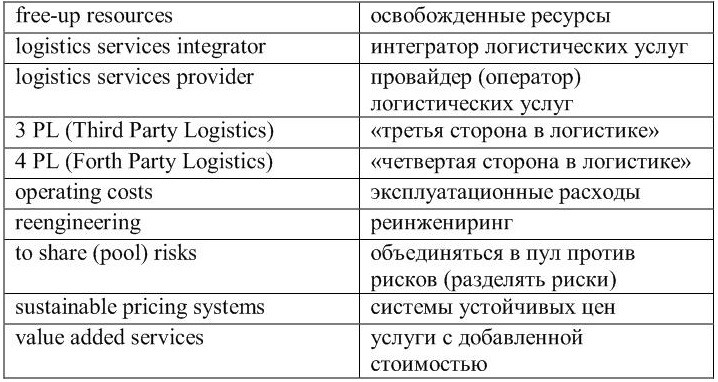
1. Observe the words and phrases from the text “Logistics Service Provider”:

5. Read and translate the text:
Logistics Service Provider
Logistics service provider is a company performing logistics activities on behalf8 of a manufacturer or distributor. Depending on the complexity and the type of value-added operations carried out by the Logistics Service Provider, such categories can be defined:
The traditional logistics service providers carry out physical logistics operations (order processing and picking, transport and storage) and whose management system is limited to tracking shipments on behalf of the client company;
Value added service providers add a certain number of services to the traditional package ranging from managing complex operational handling (co-manufacturing and co-packing), to management of administrative operations (billing and ordering) and information management (trackingtracing, etc.) These two categories refer to Third Party Logistics (3PL). The manufactures use outside sources attracting outside specialist suppliers of transport or distribution/logistics services, usually under contract (e.g. transport/ warehousing or full-scale logistics service) replacing in-house facilities.
Benefits of Outsourcing:
• Improve company focus
• Access to world-class capabilities and new technology
• Accelerated reengineering benefits
• Share (pool) risks
• Free-up resources
• Cash infusion
• Reduce and control operating costs
• Resources not available internally
• Eliminate labor problems
Challenges of 3PL are:
• Development of appropriate and sustainable pricing systems
• Finding qualified people
• Development of systems which are flexible, adoptable and user-friendly
• Development of a global logistics infrastructure.
The third category: Logistics services integrators characterized by the quasi-absence of their own physical facilities. Their role is to integrate the services of different subcontracting companies (transport, storage, valueadded operations, etc.) and to coordinate and control them through management of the associated information flows.
Whereas a third party logistics (3PL) service provider targets a function, a 4PL targets management of the entire process. Some have described a 4PL as a general contractor who manages other 3PLs, truckers, forwarders, custom house agents and others, essentially taking responsibility of a complete process for the customer. The concept 4PL provider was first defined by Andersen Consulting (Now Accenture).
2. Give English equivalents for the words and phrases given below. Make up your own sentences with these words and phrases:
вливание капитала; восполнение; выписывание счетов; запись заказов; физические логистические операции; мнимое отсутствие; облегчать; розничный торговец; сторона-подрядчик; совместное производство и упаковка; склад; субподрядная организация.
7. Complete sentences using words and expressions given below:
managing; ordering; shipments; type; operating; contractors; third; comanufacturing; sharing; problems; forwarding; value-added; service.
1. Depending on the complexity and the .........1 of ............2 operations there are several categories of the logistics service provider.
2. The management system of the traditional logistics ...... 3 providers is limited to tracking ........... 4 on behalf of the client company;
3. .........5 party logistics providers offer value added services for their customers: ............... 6 and co-packing, billing and.........7, tracking-tracing, etc.
4. Among the benefits of outsourcing one can mention .........8 risks, controlling ............9 costs, eliminating labor ...........10, accessing new technologies and others.
5. The services of 4 PL providers include .........11 3 PL providers, custom house agents, .........12, as well as a range of valueadded services.
6. Fourth party logistics providers are general ............13.
8. Answer the questions:
1. What categories of logistics service providers can be defined?
2. What operations do the traditional logistics service providers carry out?
3. What services do value-added logistics service providers add to the traditional package?
4. Logistics service providers of what type refer to 3 PL?
5. What is the role of logistics services integrators? What does the “quasi-absence of their physical facilities” mean?
6. What are the benefits of outsourcing?
7. What kind of challenges of 3PL can you name?
8. What is the concept of 4PL?
9. Translate the sentences using the text “Logistics Service Provider”:
1. Существуют компании, которые выполняют только такие логистические операции, как транспортировка и хранение.
2. Некоторые компании к традиционному пакету логистических услуг добавляют дополнительные услуги с добавленной стоимостью: выписывание счетов и составление заказов, отслеживание и контроль.
3. Когда полный комплекс услуг по логистике – от доставки и адресного хранения до управления заказами и отслеживания движения товаров – передается на сторону сторонней организации, это называется «третья сторона в логистике».
4. «Третья сторона в логистике» – это, как правило, комплексный логистический посредник для промышленной или торговой компании.
5. «Общие подрядчики» – это компании, которые интегрируют услуги различных подрядных организаций, координируют посредством управления связанные с ними информационные потоки.
6. 4PL провайдер является интегратором всей логистической цепи предприятия.
10. Translate the text and give its main idea in English:
Логистический аутсорсинг В период 1970-1980 гг. сформировались так называемые технологии инсорсинга в сфере логистических услуг: 1PL (логистика одной стороны) – когда все операции выполняет сам грузовладелец – свой транспортный парк и водительский персонал – автономная логистика. 2PL (логистика второй стороны) – когда фирма сама планирует и складирует, но не имеет транспортного парка.
В период 1980 -1990 гг. появляется 3PL (или полный аутсорсинг) – логистика третьей стороны, при которой субподрядчики занимаются логистикой фирмы, фирма сама не занимается внешней логистикой.
В период 1990-2000 гг. сформировался 4PL (четвертая сторона в логистике), – когда фирма пользуется услугами генератора логистики, т.е. системного логистического интегратора, предоставляющего услуги по проектированию, интегрированному планированию цепей поставок компании.
Некоторые специалисты полагают, что в связи с развитием электронного бизнеса могут произойти изменения в логистике и возникнет следующий уровень логистических систем операторов – провайдеров – 5PL. Эти провайдеры – виртуальные интегрированные логистические операторы.
11. Translate the sentences given below using the Unit Vocabulary:
1. The use of the company’s inner resources is called “insourcing”.
2. The rising costs of offshore production have driven corporations to “insourcing”.
3. Adverse macroeconomic conditions accentuate the need for corporations to focus on cost containment in their supply chains.
4. “By 2010, the need for greater supply chain flexibility will overtake product quality and customer service as the major driver for improving supply chain strategy.” (Global Supply Chain Trends Survey, 2008).
5. “A lot of our supply chain design work was really developed in the 1980s and 1990s, when our capital spending was fairly high and oil was 10 bucks a barrel. I could say that the supply chain design is now upside down. The environment has changed.” (Keith Harrison, Procter & Gamble, Head of Global Supply Chain (Financial Times).
12. Complete each dialogue with the correct form of “going to”, “will”, the present continuous and the present simple (See Language Notes):
1. A: What are you planning to do now? B: We…sign the treaty with the contracting party.
2. A: We need to wait for the truck to come. B: Oh, don’t worry. I ...... (do) billing and ordering.
3. A: We’ve decided to add more services to our usual package. B: Really. What services … you (offer)?
4. A: What about your plans of a new sub-contracting company? B: Well, we..... (outsource) some kinds of production and distribution next year.
5. A: Have you made up your mind to use outside sources? B: Yes, the company ...... (outsource) transport and warehousing services.
6. A: Are you ready for leaving? B: Yes, the plane… (depart) at 7 p.m.
7. The following Monday the representatives of the logistics services integrator… (come) for the meeting.
8. A: What are your nearest plans? B: We all… (develop) appropriate and sustainable pricing systems.
13. Retell the text “Logistics Service Provider” according to the plan:
A. The traditional Logistics Service Providers;
B. The value-added Logistics Service Providers;
C. «Third-Party Logistics» Providers; benefits of outsourcing;
D. Challenges of 3 PL providers;
E. Logistics services integrators or 4PL providers.
SITUATION PRACTICE
14. Make the dialogue about logistics service providers:
Useful language: Asking for clarification
What exactly are you saying? What exactly do you mean? Are you saying we need to…? Sorry, I don’t follow you.
Can you explain in more detail?
What I mean is.........
What I’m saying is.......
No, I was thinking of......
To be more specific...... To clarify the matter…
They suggest.....The company proposes that.....
Более 800 000 книг и аудиокниг! 📚
Получи 2 месяца Литрес Подписки в подарок и наслаждайся неограниченным чтением
ПОЛУЧИТЬ ПОДАРОКДанный текст является ознакомительным фрагментом.