Unit 3. Carrier’s liability
A. Read the English texts and translate them.
3.1 Basic Liability
3.1.1 The Carrier shall be liable for loss of or damage to the goods occurring between the time when he receives the goods into his charge and the time of delivery.
3.1.2 The Carrier shall be responsible for the acts and omissions of any person of whose services he makes use for the performance of the contract of carriage evidenced by this Bill of Lading.
3.1.3 The Carrier shall, however, be relieved of liability for any loss or damage if such loss or damage arose or resulted from:
(a) The wrongful act or neglect of the Merchant.
(b) Compliance with the instructions of the person entitled to give them
(c) The lack of, or defective conditions of packing in the case of goods which, by their nature, are liable to wastage or to be damaged when not packed or when not properly packed.
(d) Handling, loading, stowage or unloading of the goods by or on behalf of the Merchant.
(e) Inherent vice of the goods.
(f) Insufficiency or inadequacy of marks or numbers on the goods, covering, or unit loads.
(g) Any cause or event which the Carrier could not avoid and the consequences whereof he could not prevent by the exercise of reasonable diligence.
3.1.4 Where under sub-clause 9 (3) the Carrier is not under any liability in respect of some of the factors causing the loss or damage, he shall only be liable to the extent that those factors for which he is liable under this clause have contributed to the loss or damage.
3.1.5 The burden of proving that the loss or damage was due to one or more of the causes or events, specified in (a), (b) and (g) of sub-clause 9 (3) shall rest upon the Carrier.
3.1.6 When the Carrier establishes that in the circumstances of the case, the loss or damage could be attributed to one or more of the causes or events, specified in (c) to (g) of sub-clause 9 (3), it shall be presumed that it was so caused. The Merchant shall, however, be entitled to prove that the loss or damage was not, in fact, caused either wholly or partly by one or more of the causes or events.
3.2 Amount of compensation
3.2.1 The value of the goods shall be fixed according to the commodity exchange price or, if there be no such price, according to the current market price or, if there be no commodity exchange price or current market price, by reference to the normal value of goods of the same kind and quality.
3.2.2 Compensation shall not, however, exceed two Special Drawing Rights per kilogramme of gross weight of the goods lost or damaged.
3.2.3 Higher compensation may be claimed only when, with the consent of the Carrier, the value of the goods declared by the Shipper which exceeds the limits laid down in this clause has been stated on the face of this Bill of Lading at the place indicated. In that case the amount of the declared value shall be substituted for that limit.
3.3 Special Provisions for Liability and Compensation
3.3.1 Notwithstanding anything provided for in Clauses 9 and 10 of this Bill of Lading, if it can be proved where the loss or damage occurred, the Carrier and the Merchant shall, as to the liability of the Carrier, be entitled to require such liability to be determined by the provisions contained in any international convention or national law, whose provisions:
(a) cannot be departed from by private contract, to the detriment of the claimant, and
(b) would have applied if the Merchant had made a separate and direct contract with the Carrier in respect of the particular stage of transport where the loss or damage occurred and received as evidence thereof any particular document which must be issued if such international convention or national law shall apply.
3.3.2 Insofar as there is no mandatory law applying to carriage by sea by virtue of the provisions of sub-clause 11 (1), the liability of the Carrier in respect of any carriage by sea shall be determined by the International Brussels Convention 1924 as amended by the Protocol signed at Brussels on February 23rd 1968 – the Hague/Visby Rules.
The Hague/Visby Rules shall also determine the liability of the Carrier in respect of carriage by inland waterways as if such carriage were carriage by sea. Furthermore, they shall apply to all goods, whether carried on deck or under deck.
3.4 Delay, Consequential loss, etc.
If the Carrier is held liable in respect of delay, consequential loss or damage other than loss of or damage to the goods, the liability of the Carrier shall be limited to the freight for the transport covered by this Bill of lading, or to the value of the goods as determined in Clause 10, whichever is the lesser.
3.5 Notice of Loss of or Damage to the Goods
3.5.1 Unless notice of loss of or damage to the goods, specifying the general nature of such loss or damage, is given in writing by the Merchant to the Carrier when the goods are handed over to the Merchant, such handing over is prima facie evidence of the Delivery by the Carrier of the goods as described in this Bill of Lading.
3.5.2 Where the loss or damage is not apparent, the same prima facie effect shall apply if notice in writing is not given within three (3) consecutive days after the day when the goods were handed over to the Merchant.
3.6 Defences and Limits for the Carrier, Servants, etc.
3.6.1 The defences and limits of liability provided for in this Bill of Lading shall apply in any action against the Carrier for loss or damage to the goods whether the action can be founded in contract or in tort.
3.6.2 The Carrier shall not be entitled to the benefit of the limitation of liability provided for in sub-clause 10 (3), if it is proved that the loss or damage resulted from a personal act or omission of the Carrier done recklessly and with knowledge that damage would probably result.
3.6.3 The Merchant undertakes that no claim shall be made against any servant, agent or other persons whose services the Carrier has used in order to perform this Contract, and if any claim should nevertheless be made, to indemnify the Carrier against all consequences thereof.
3.6.4 In entering into this Contract, the Carrier, to the extent of such provisions, does so not only on his own behalf but also as agent or trustee for such persons. The aggregate liability of the Carrier and such persons shall not exceed the limits in Clauses 10, 11, and 24, respectively.
B.1 Active word-list
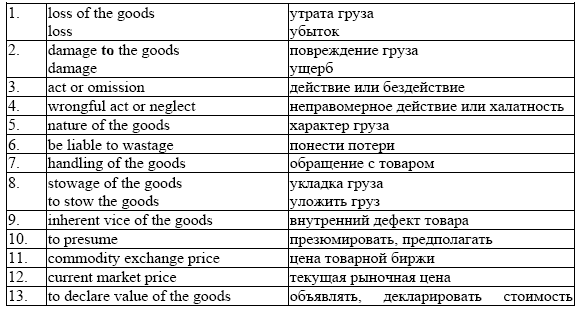
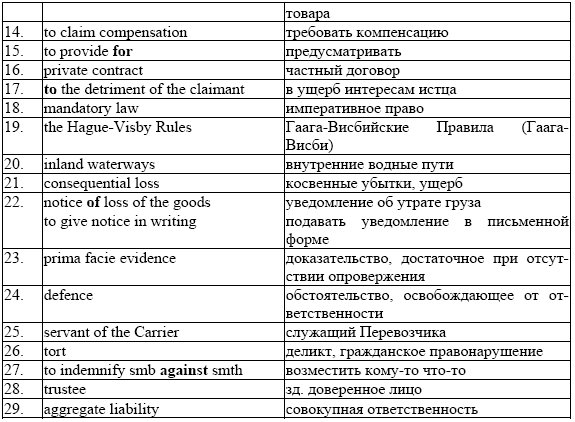
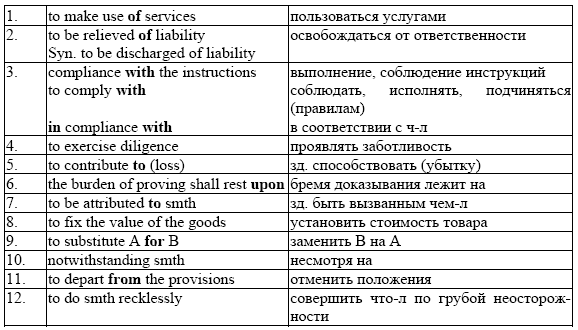
B.2 Remember these useful words and phrases:
C. Exercises
1. Translate these phrases into English using the texts if necessary.
1. утрата или повреждение груза происходит в период времени
2. чьими услугами он пользуется для исполнения договора
3. перевозчик освобождается от ответственности за любой убыток или ущерб
4. убыток возник из неправомерного действия или халатности торговца
5. в случае если товар, в силу своего характера, может понести потери
6. обращение с товаром, погрузка, укладка осуществляется торговцем или от его имени
7. любое событие, которого Перевозчик не мог избежать, и последствия которого не мог предотвратить, действуя с разумной заботливостью
8. только в той степени, в которой эти факторы способствовали убытку или ущербу
9. если Перевозчик установит, что убыток или ущерб могли быть вызваны какой-то причиной, следует предположить, что так оно и было.
10. компенсация рассчитывается исходя из стоимости данного груза
11. стоимость товара устанавливается в соответствии с ценой товарной биржи
12. два СДР за килограмм веса брутто утерянного или поврежденного груза
13. в этом случае предел заменяется суммой объявленной стоимости
14. положения нельзя отменить частным договором в ущерб интересам истца
15. если признана ответственность Перевозчика за задержку, косвенный убыток или ущерб, за исключением утраты или повреждения груза…
2. Translate these phrases into Russian quickly.
1. The Merchant undertakes to indemnify the Carrier against all consequences thereof (claims).
2. the loss or damage resulted from a personal act or omission of the Carrier
3. done recklessly or with knowledge that damage would probably result
4. The Carrier shall not be entitled to the benefit of the limitation of liability
5. this Bill of Lading provides for the defences and limits of liability
6. whether the action can be founded in contract or in tort
7. the handing over of the goods is prima facie evidence of the delivery
8. notice of loss of or damage to the goods specifies the general nature of such loss or damage
9. liability is limited to the freight or to the value of the goods, whichever is the lesser
10. to determine the liability in respect of carriage by inland waterways as if such carriage were carriage by sea.
3. Match the words in column A with those in column B.
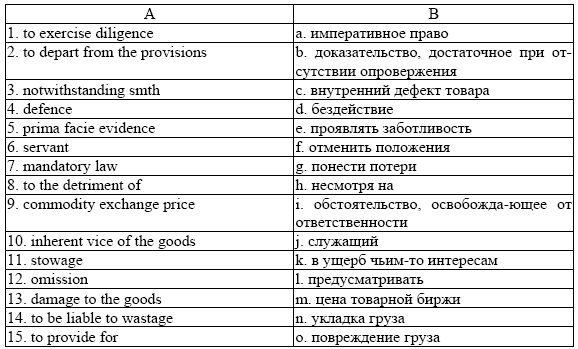
4. Fill the gaps with prepositions.
1. The Carrier shall be relieved … liability … any loss or damage which resulted … compliance … the instructions of the person entitled to give them.
2. The Carrier shall be responsible … the acts and omissions of any person … whose services he makes use … the performance of this contract evidenced … this Bill of Lading.
3. … in the case of the goods which, … their nature, are liable … wastage.
4. Where … clause 9 the Carrier is not … any liability … respect … the factors causing the loss or damage.
5. The burden of proving that the loss or damage was due … one or more of the causes or events shall rest … the Carrier.
6. The defences and limits of liability provided … in this Bill of Lading shall apply … any action … the Carrier … loss … or damage … the goods.
7. The Merchant undertakes that no claim shall be made… any servant, agent of the Carrier and if any claim should be made, to indemnify the Carrier… all consequences…
8.. the Carrier’s consent, the value of the goods has been stated… the face of this Bill of Lading… the place indicated.
9. In that case the amount of the declared value shall be substituted… that limit.
5. Translate into English.
Более 800 000 книг и аудиокниг! 📚
Получи 2 месяца Литрес Подписки в подарок и наслаждайся неограниченным чтением
ПОЛУЧИТЬ ПОДАРОК